
AI-Powered Search
for Medical Device QMS
Finding evidence in a regulated QMS shouldn’t feel like a forensic investigation.
Ask natural questions and get instant, audit-ready answers across your entire quality system.
Search by intent, not just keywords.
Search Your QMS the Way You Think
Traditional QMS search relies on exact keywords.
AI-powered search doesn’t.
qmsWrapper understands intent and context using semantic retrieval logic, so you can ask real questions and get real answers — even when different teams use different terminology.
Examples:
- Find all SOPs updated this year
- Show all CAPAs with open actions
- Documents linked to Risk-12
You don’t search where things live.
You search what you need.
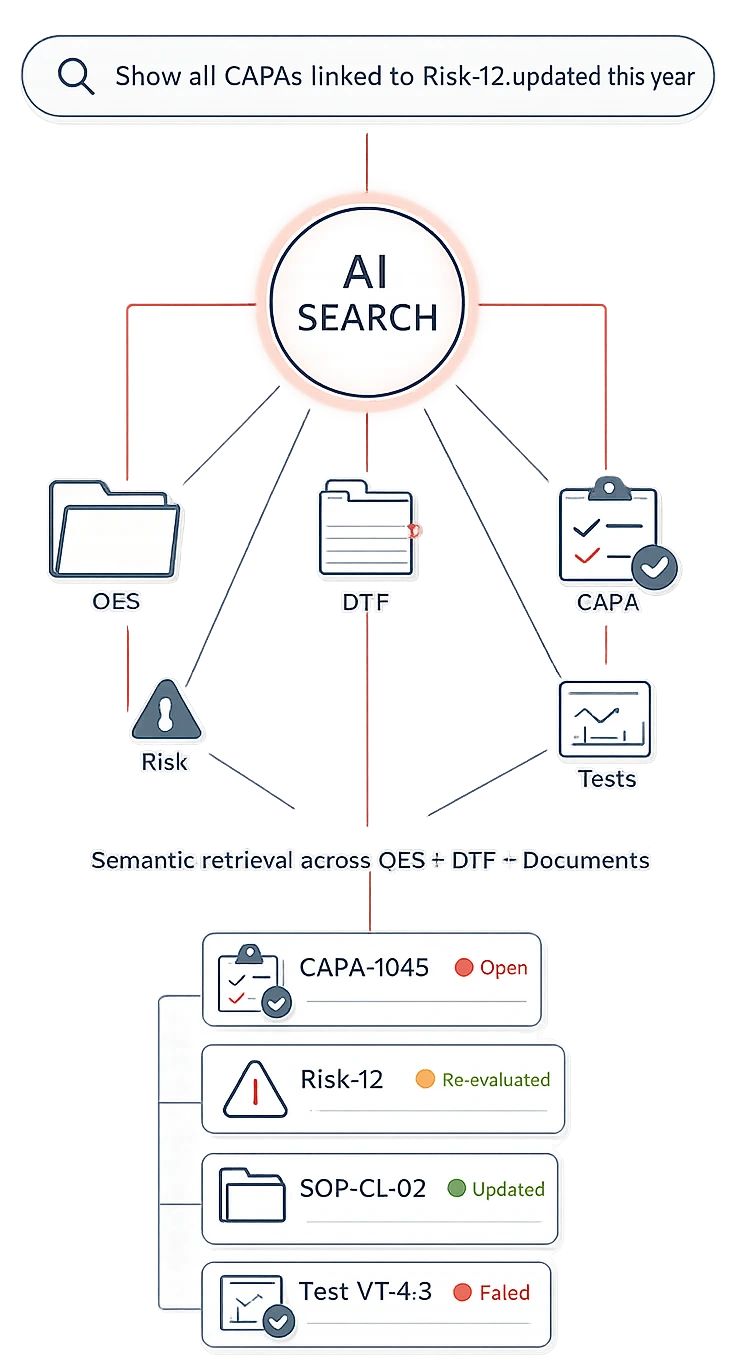
Less hunting. More certainty
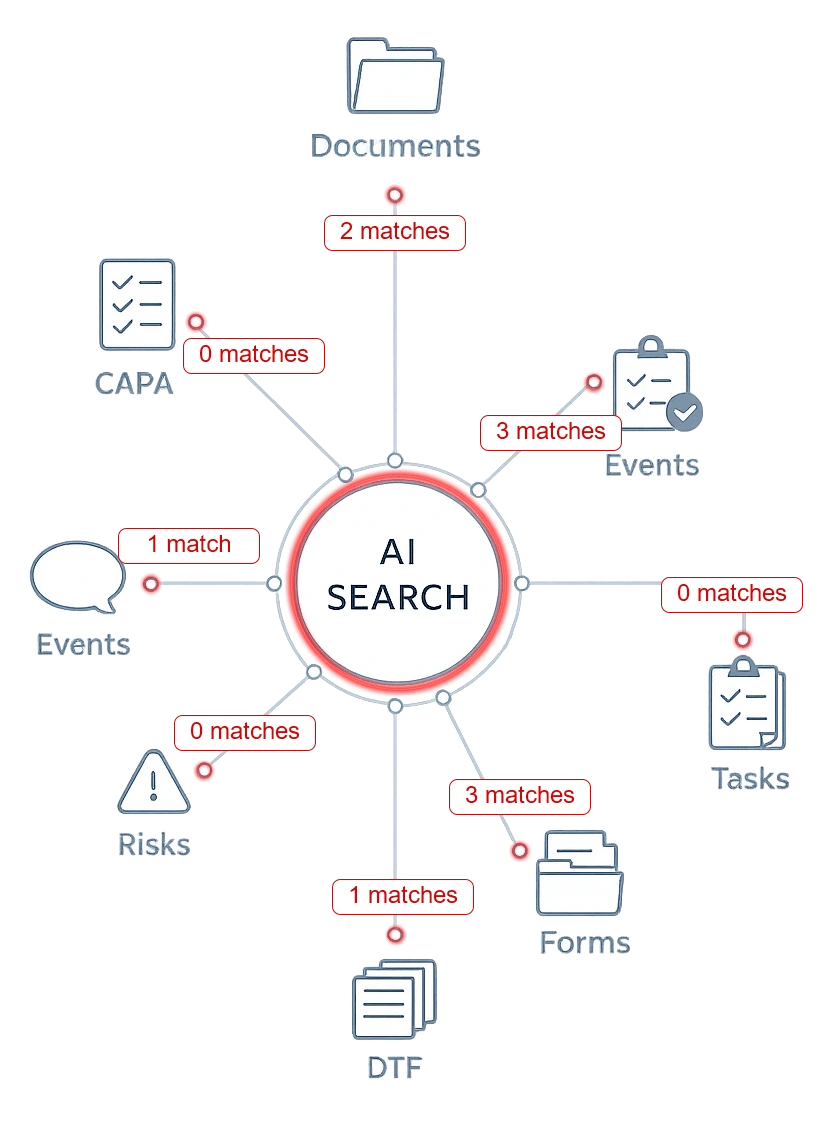
One Search Across the Entire QMS
AI-powered search goes far beyond documents.
It searches your entire quality system — not just file names.
Across:
- Documents
- QMS records (CAPA, NCR, changes)
- Events
- Risks
- Tasks and forms
Everything is connected.
Because the system understands relationships — not just words — AI-powered search retrieves connected context, not isolated files.
If it exists in qmsWrapper, AI search finds it.
Built for Global, Multilingual Teams
Medical device teams work globally — and so should QMS search.
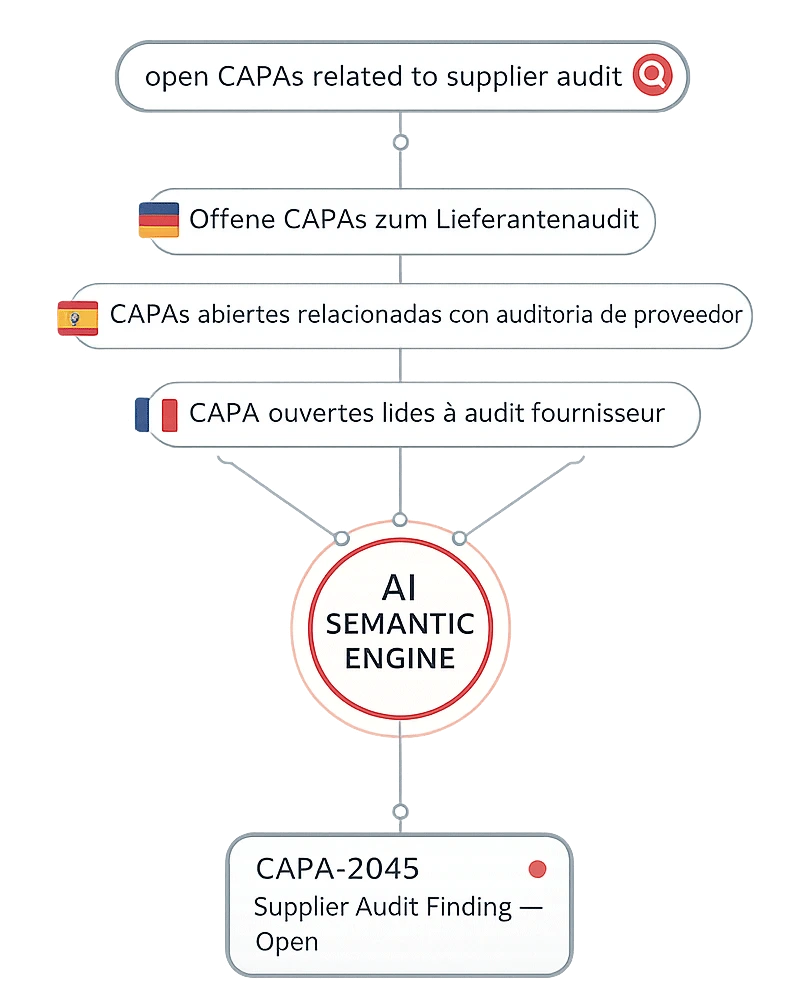
AI-powered search is multilingual by design:
- Search in your language
- Retrieve records in another
- Stay aligned without translation workarounds
The underlying semantic engine interprets meaning across languages, reducing ambiguity and terminology mismatch.
One system.
One shared understanding.
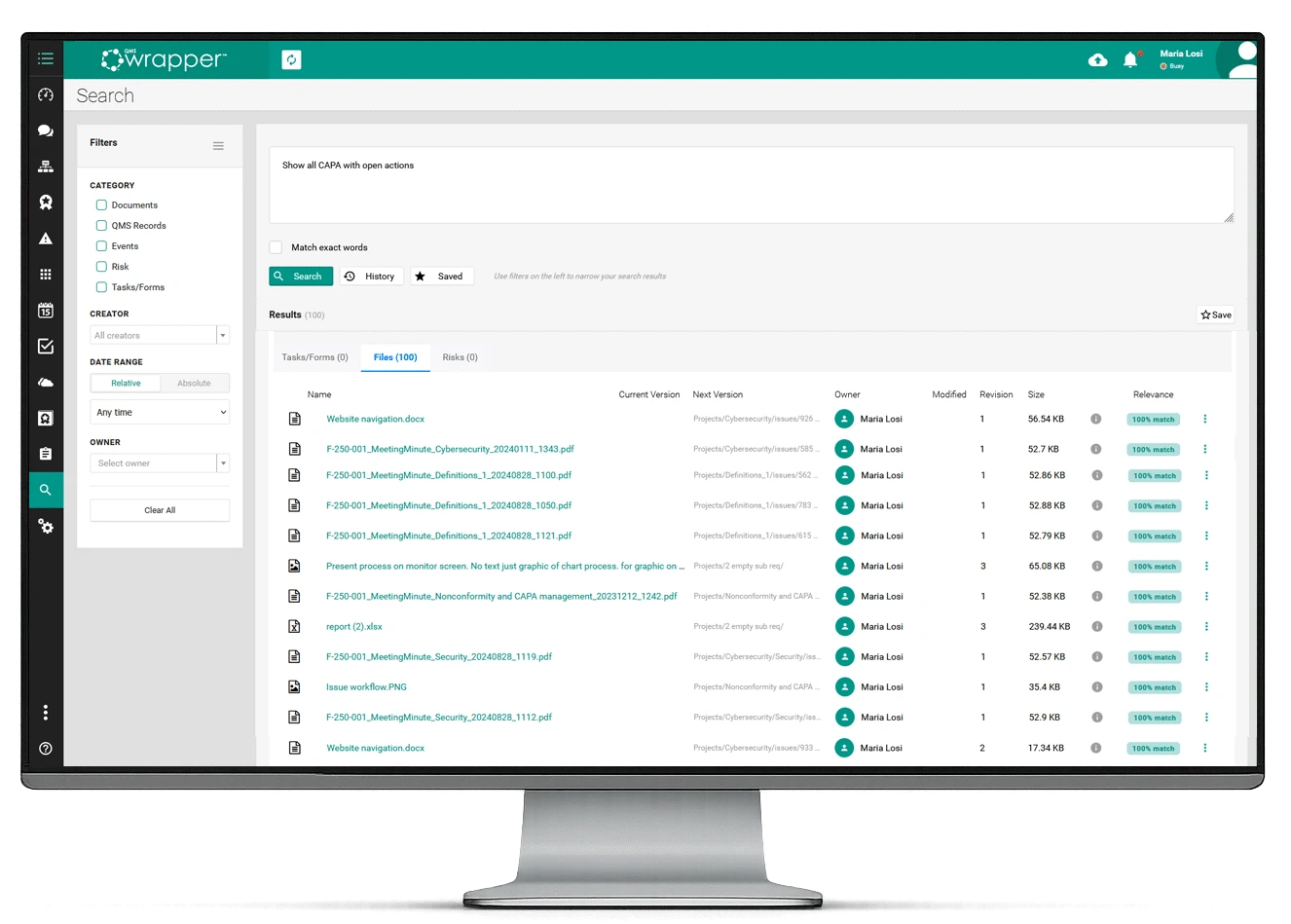
Audit-Ready Answers, Instantly
When audits or investigations start, speed matters.
AI-powered search lets you:
- Retrieve evidence instantly
- Spot open or overdue actions
- Trace documents, risks, and CAPAs in seconds
- Surface connected records across modules
No spreadsheets. No digging.
Just clear, defensible answers.
See AI-Powered Search in Action
Finding information is one step.
Understanding its impact is what makes your QMS effective.
The fastest way to understand the impact
is to see it on your own QMS data.
What Quality & Regulatory Teams Ask About AI-Powered QMS Search
How is AI-powered search different from traditional QMS search?
Traditional QMS search works like a document finder — it relies on exact keywords and file names.
AI-powered search in qmsWrapper uses semantic retrieval logic. It understands intent, relationships, and context. You can ask natural questions like:
- “Show all CAPAs with open actions”
- “Find documents linked to Risk-12”
- “Which SOPs were updated this year?”
The system retrieves structured answers across modules — not just matching file names.
Can AI search retrieve information across CAPA, Risk, DHF, and Events?
Yes.
AI-powered search is not limited to documents. It searches across:
- CAPA records
- Non-Conformances (NCR)
- Change Controls
- Risk Assessments
- Design Traceability File (DTF) elements
- Tasks and workflow forms
- Controlled documents
Because qmsWrapper connects QES (Quality Event System) and DHS/DTF (Design History System), search results include linked context — not isolated records.
Is AI search compliant with ISO 13485 and FDA 21 CFR Part 820 expectations?
AI search does not replace structured QMS processes — it enhances visibility.
All records remain fully version-controlled, audit-trailed, and workflow-governed in accordance with:
- ISO 13485:2016
- FDA 21 CFR Part 820 / QMSR
- EU MDR design control and PMS requirements
AI search simply enables faster retrieval of evidence, traceability links, and lifecycle history — which strengthens audit readiness.
Can AI search support Technical File and DHF traceability?
Yes.
AI-powered search can retrieve and connect:
- Use Cases
- Requirements
- Risks
- Design Inputs (DI)
- Design Outputs (DO)
- Verification & Validation records
- Linked Change Controls
Instead of manually navigating logs, teams can ask direct questions and instantly trace design changes across the Design History File (DHF) or Technical File (TF).
Does AI search work across languages?
Yes.
qmsWrapper AI search is multilingual by design. Teams can:
- Search in one language
- Retrieve records stored in another
- Avoid terminology mismatch between departments or regions
The semantic engine interprets meaning, not just literal wording — supporting global MedTech teams working under shared regulatory frameworks.
How does AI search help during audits?
During internal or external audits, AI search allows teams to:
- Retrieve linked CAPA and Risk records in seconds
- Identify overdue or open actions instantly
- Surface document revision history
- Trace Change Control impact across design and quality
Instead of exporting spreadsheets or manually reconciling logs, teams access defensible answers directly within the system.
Does AI search modify or auto-edit records?
No.
AI search retrieves information — it does not automatically change or approve records.
All QMS actions (CAPA initiation, Change Control, Risk updates, document revisions) remain governed by defined workflows and electronic approval processes.
AI enhances visibility, not authority.
Is AI search secure and role-based?
Yes.
Search results respect user permissions. Users only retrieve records they are authorized to access based on role, project, and system permissions.
Data governance remains intact.
Can AI search reduce investigation time?
In many cases, yes.
By eliminating manual cross-checking between logs and modules, AI search reduces the time required to:
- Investigate complaints
- Perform root cause analysis
- Prepare audit evidence
- Assess design impact
This supports risk-based thinking and faster, structured decision-making.