
AI QMS for Medical Devices
Understand what must change before you act.
Most QMS systems document change.
Few help you understand its impact across requirements, risk, and the Technical File.
This report explains how operational AI changes that.
Table of Contents
Why AI Is Becoming Critical for Medical Device QMS
Medical device regulations don’t just require documentation.
They require:
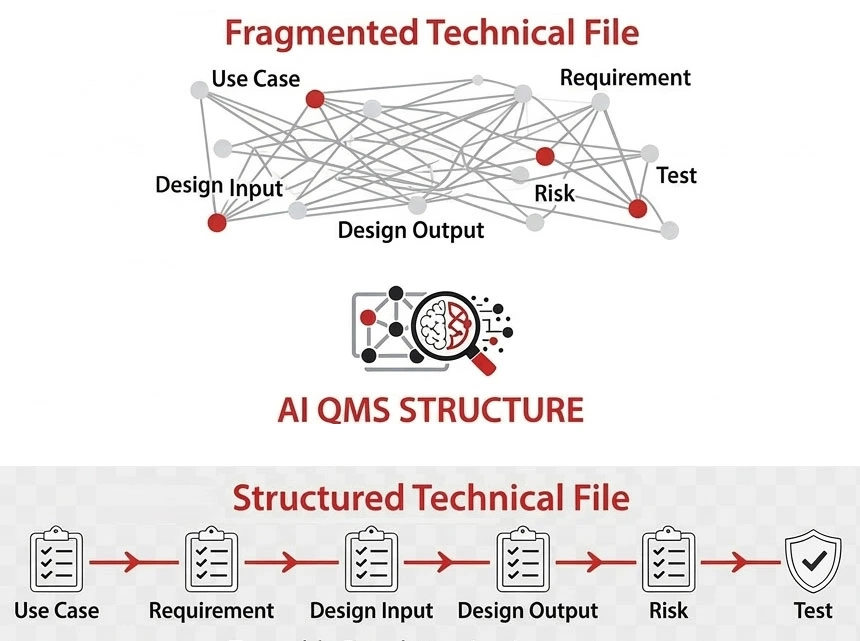
- traceability across the Technical File
- documented change impact analysis
- clear connections between risk, requirements, and verification
Most teams still manage this manually.
The Real Problem Isn’t Documentation
A single change can affect:
- multiple requirements
- risk assessments
- verification activities
- documentation
But most QMS systems don’t show these connections.
They leave teams to figure it out manually.
The real challenge is understanding what must change when something changes.
AI in QMS Is Often Misunderstood
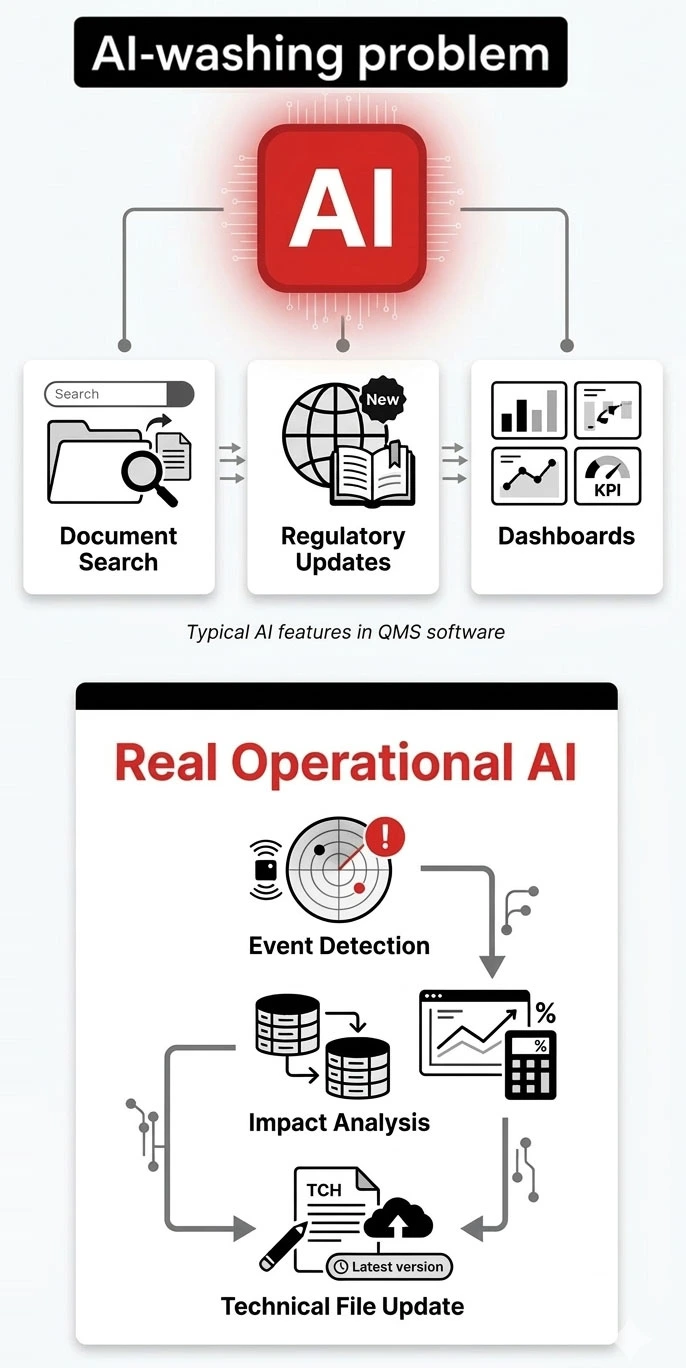
Most platforms offer:
- dashboards
- search
- regulatory updates
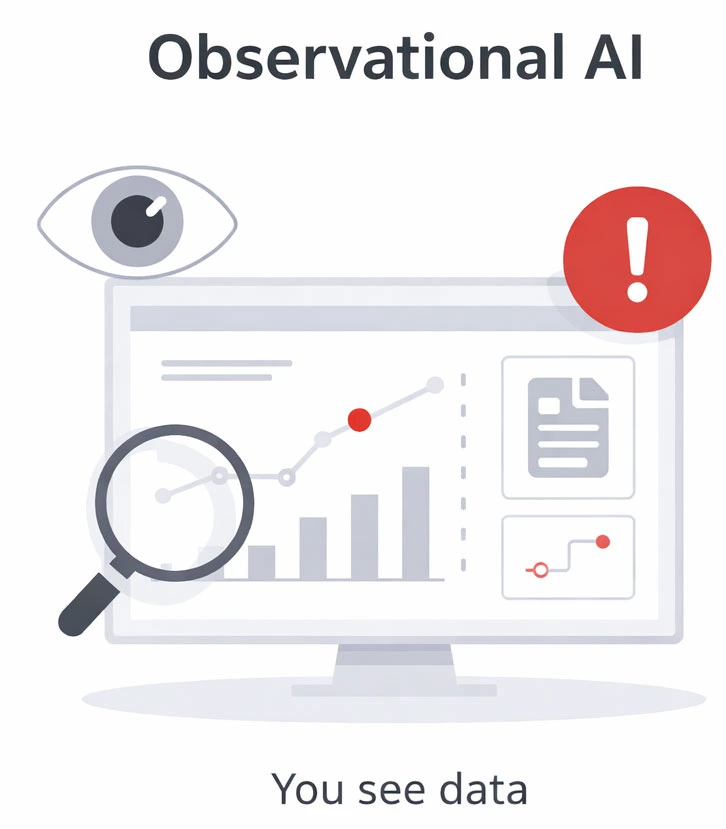
This is observational AI.
It helps you see data, but not manage change.
Operational AI Changes the Workflow
Instead of analyzing data after the fact,
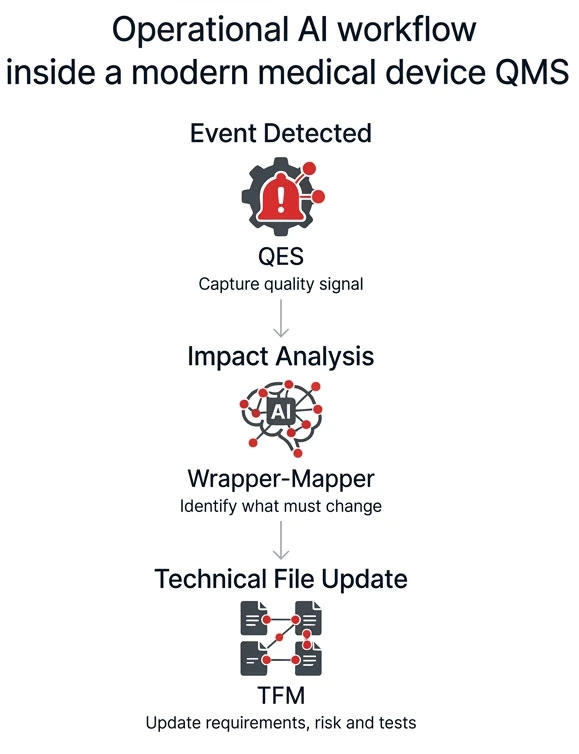
operational AI works inside the QMS.
It helps:
- evaluate events
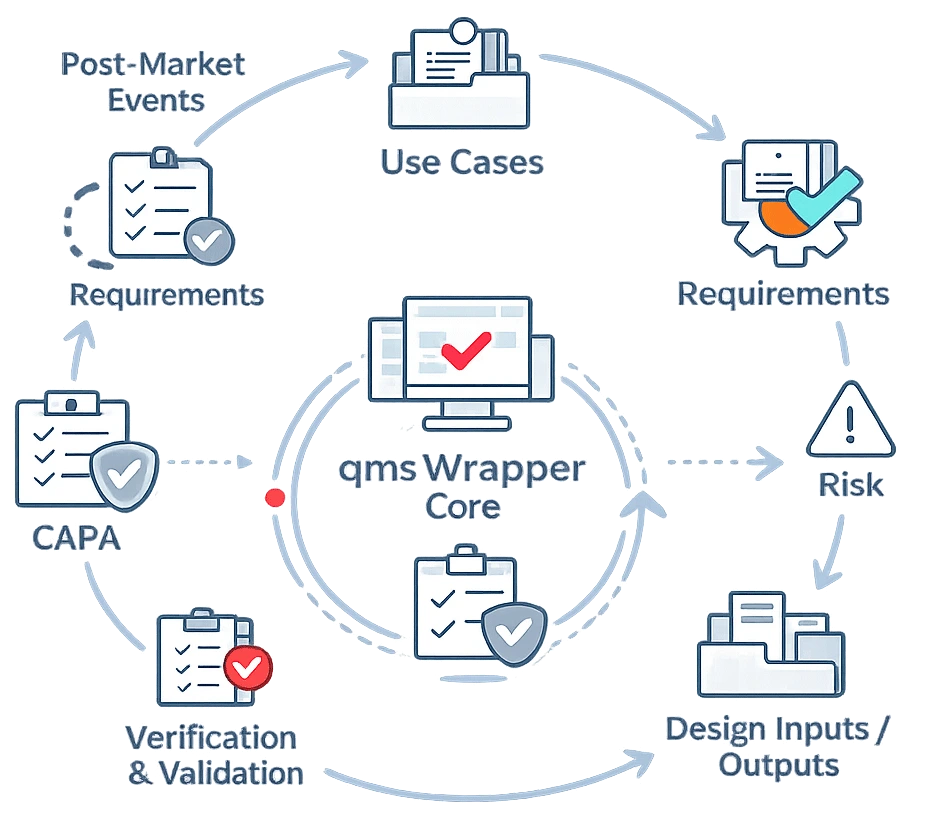
- analyze change impact
- update the Technical File
- maintain traceability
What You Will Learn in the Report
- why most “AI in QMS” is surface-level
- what real change impact analysis actually requires
- how operational AI supports traceability in practice
- how modern QMS systems connect risk, requirements, and testing
- how hybrid AI (SQL + semantic search) works in real workflows
Download the AI QMS Report
Learn how operational AI supports medical device compliance and audit readiness.
The report explores:
- AI architecture in modern QMS systems
- the role of change impact analysis
- how search intelligence supports regulatory traceability
Common Questions About AI QMS for Medical Devices
What is an AI QMS for medical devices?
An AI QMS for medical devices embeds artificial intelligence into daily compliance workflows: evaluating quality events, performing change impact analysis, maintaining traceability across the Technical File, and updating regulated documentation. Unlike retrieval-style AI assistants, an AI QMS acts on the compliance record itself under ISO 13485 and FDA 21 CFR Part 820.
How does AI help medical device compliance?
AI accelerates medical device compliance by linking quality events to affected requirements, risks, and verification evidence, then proposing updates to design controls, CAPA records, and the Technical File. This reduces manual cross-referencing that auditors expect under ISO 14971 and ISO 13485, while preserving the human review needed for regulated decisions.
What makes operational AI different?
Operational AI acts inside the compliance workflow instead of beside it. Where retrieval AI fetches documents or summarizes queries, operational AI evaluates incoming quality events, classifies them by risk, links them to the records they affect (CAPA, risk file, design controls), and pre-fills the regulated update for human review.
Why is change impact analysis important?
Change impact analysis is the regulator-required step that shows how a design change ripples through risk assessments, verification testing, and Technical File content. Under ISO 13485 and EU MDR, missing or incomplete impact analyses are a common audit finding. Doing it manually scales poorly as device complexity grows, which is why AI-assisted cross-referencing matters here.
How qmsWrapper’s AI maps to the EU AI Act and FDA expectations
Because qmsWrapper’s AI proposes and humans approve, it produces the governance evidence regulators now expect. Coverage includes:
- EU AI Act (Regulation 2024/1689) Articles 9 to 15 (risk management, data governance, technical documentation, logging, transparency, accuracy and cybersecurity), plus Article 17 (QMS).
- EU AI Act Article 14 (human oversight), Article 50 (transparency), and Article 72 (post-market monitoring), with Annex IV technical documentation.
- FDA SaMD (2017), Clinical Decision Support (2022), Good Machine Learning Practice (2021), and Predetermined Change Control Plan (2024).
- IEC 42001:2023 (AI management systems) and ISO/IEC 23894:2023 (AI risk management).
- FDA 21 CFR Part 11 electronic signatures on every AI Findings approval, for human-in-the-loop log integrity.