

Why semantic AI Search is the missing glue between quality, design, and risk
There’s one audit moment QMS Managers dread—not because they did something wrong, but because proving it is exhausting.
The auditor asks:
“Show me how this issue connects to risk, design, and verification evidence.”
You know the story exists.
You know the team handled it.
But the evidence is scattered across:
- CAPA records
- risk files
- verification reports
- meeting notes
- document repositories
So you spend hours—or days—pulling threads together.
That’s not “compliance.”
That’s manual reconstruction.
The pain isn’t missing data. It’s missing connection.
Many companies do have the information.
The problem is:
- it’s stored in separate places
- labeled differently by different teams
- disconnected from the chain auditors care about
Traditional search makes this worse because it only looks for exact words.
Which leads to a common frustration:
“I know it’s in there. I just can’t find it.”
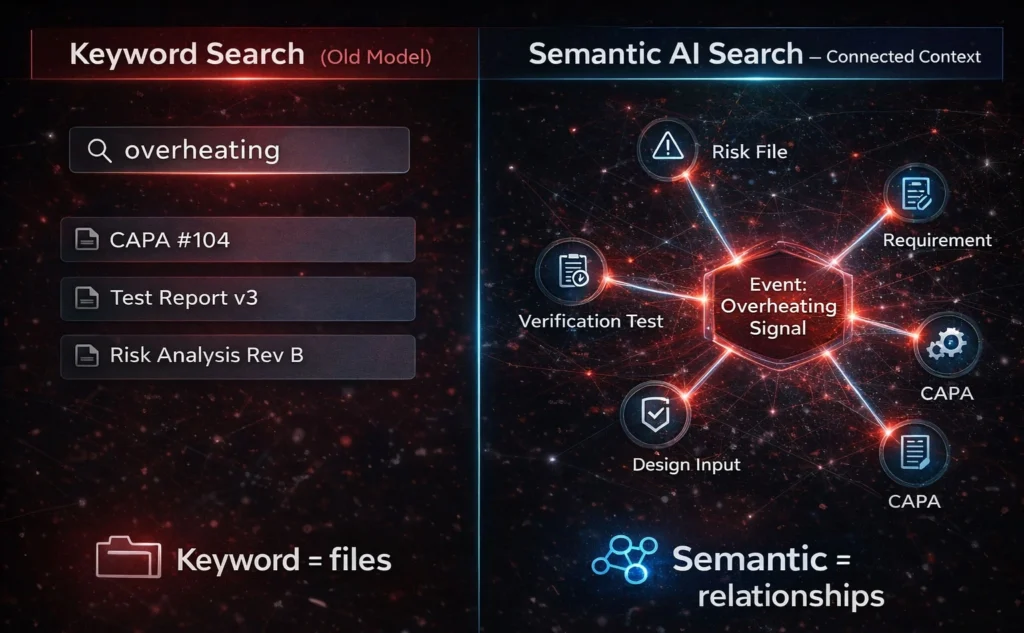
The old model: keyword search (Windows Explorer logic)
Most search tools behave like this:
You type “overheating”
It returns files containing the word “overheating.”
But in real life, your records may say:
- “thermal instability”
- “high temperature deviation”
- “temperature spike during stress test”
Same meaning. Different words.
Keyword search misses context, which is exactly what audits require.
The shift: searching for meaning (semantic context)
That’s why qmsWrapper uses the term:
AI Search
Not as a marketing buzzword, but as a practical capability:
Semantic AI Search retrieves information by meaning, not just by matching text.
So when you search “overheating,” the system can surface:
- related Events in QES
- linked risks in DTF
- impacted requirements
- relevant tests and evidence
- associated documents
This is why we call it the “glue.”
Because it connects what is otherwise disconnected.
What this changes for a QMS Manager
The goal isn’t “faster search.”
Finding the connection is one thing.
Understanding what it means for your system is another.
See how change impact is actually managed in our AI QMS report
The goal is:
faster answers with traceable context.
In practice, semantic AI Search helps you:
- find related Events even if they use different wording
- see the compliance story across modules
- retrieve evidence without audit prep marathons
- connect quality signals to design and risk decisions
That is what auditors evaluate: the chain, not the folder structure.
A realistic example QMS Managers recognize
A complaint comes in describing “warm device housing.”
In different places, teams might document it as:
- “temperature spike” (test report)
- “thermal instability” (risk file)
- “overheating” (support ticket)
- “heat-related usability issue” (feedback)
Traditional search forces you to guess the right keyword.
Semantic AI Search lets you retrieve the story without guessing.
Micro-glossary
- AI Search: semantic retrieval across quality, design, risk, tests and documents
- Semantic context: search by meaning, not exact wording
- Compliance story: the linked chain auditors ask for (signal → evaluation → decision → evidence)
The qmsWrapper Logic
Capture → Structure → Retrieve → Defend
- QES (Capture): Every quality signal becomes a documented Event.
- DTF (Structure): Every requirement, risk, and test remains connected through the lifecycle.
- AI Search (Retrieve): Every decision and link can be retrieved instantly, across modules.
Result: Structured, defensible compliance — not reactive documentation.
Terminology Clarified
- Event: A documented starting point of a quality signal before escalation.
- QES: The controlled intake and triage layer of your QMS.
- DTF: The structured design control environment that keeps traceability intact.
- AI Search: Semantic retrieval across quality, design, risk, and evidence.
What Comes Next
First, we made it possible to capture every signal.
Then, to keep it structurally connected.
Soon, we will show how structured events can be intelligently mapped into controlled execution — always with human approval at critical decisions.
FAQ: AI-Powered QMS for MedTech
Is semantic AI Search just a faster keyword search?
No. It retrieves related records by meaning, even when different terms are used.
What does it search across?
Events, structured traceability records, documents, and test evidence—so you can see the full chain.
Why does this matter for audits?
Because audits require linkage and rationale. Semantic AI Search reduces manual “stitching” of records across silos.
Does semantic AI Search replace good documentation?
No. It makes well-structured documentation accessible and defensible in seconds.
Capture first. Connect next. Mapping is coming.