

Table of Contents
Change control in medical devices often begins later than it should.
By the time the change control process starts, the original signal may have appeared weeks earlier.
A change request is opened.
The impact is evaluated.
The Technical File is updated.
On paper, the process looks correct.
But in reality, the most important part of the story usually happens before change control even begins.
By the time a formal change request is created, the real signal has already appeared somewhere else.
And that delay can create traceability gaps.
The Moment Change Control in Medical Devices Actually Begins
Change rarely begins with a formal document.
In reality, change control in medical devices usually begins with an early signal that appears before any formal process starts.
An engineer notices something during testing.
A field engineer reports unusual behavior.
A customer complaint describes a performance issue.
A risk assessment reveals a previously overlooked scenario.
These signals often appear in informal channels:
• an email
• a meeting discussion
• a comment in a test report
• a short message in a collaboration tool
The team may discuss the observation briefly and decide it is not critical.
Or they may agree to “keep an eye on it.”
Weeks later, the issue resurfaces.
Only then does someone open a formal Change Control record.
From a regulatory perspective, this creates an important question:
When did the evaluation actually begin?
The Hidden Gap in Change Control in Medical Devices
Traditional change control processes assume that change begins when the change request is created.
But regulators evaluate the decision process, not only the documentation.
Auditors frequently ask questions such as:
When was the signal first observed?
Who evaluated its relevance?
What rationale was used to decide whether escalation was necessary?
If the initial evaluation happened informally, the organization may struggle to reconstruct that decision later.
This is how many teams end up performing what some quality managers call “documentation archaeology.”
Reconstructing the reasoning behind past decisions shortly before an audit.
Why Early Signals Matter
Medical device development involves tightly connected elements across the Technical File.
A single observation may affect multiple components of the system:
• design requirements
• risk management documentation
• verification protocols
• manufacturing specifications
When a change is evaluated late, identifying these relationships becomes more difficult.
Teams must manually search across documents to determine which elements might be affected.
This slows down the change process and increases the risk of missed traceability links.
Modern quality systems increasingly address this challenge by improving change control in medical devices through earlier signal capture.
Identifying a signal early is one thing.
Keeping everything connected after that is another.
See why traceability breaks when a requirement changes
Change Control Should Not Be the Starting Point
In a modern medical device QMS, built on the foundations of ISO 13485:2016 quality management standards, change control should represent the execution phase of change management, not the beginning.
Before a change request is created, the organization must first understand the signal that triggered the change.
This initial stage typically involves:
- capturing the signal
- evaluating potential impact
- deciding whether escalation is necessary
Only after this evaluation should formal change control begin.
When this sequence is clear, organizations gain a much more defensible compliance narrative.
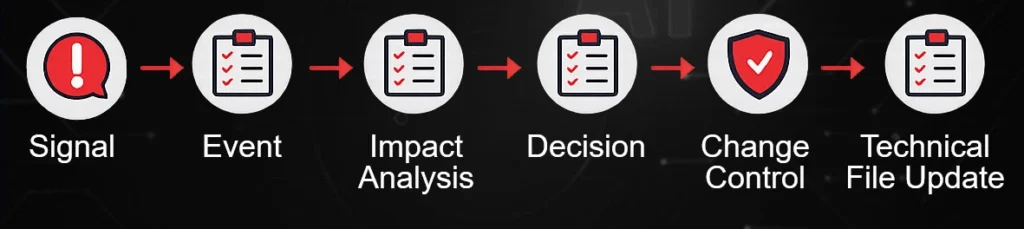
Signal → Event → Impact Analysis → Decision → Change Control → Technical File Update
The Role of Structured Event Capture
To support this workflow, many modern QMS platforms introduce a structured event layer.
Instead of relying on informal communication, signals are captured as structured quality events at the moment they appear. Many modern QMS architectures describe this stage as an event capture layer, where signals are formally recorded before any change control process begins.
These events may include:
- deviations
- engineering observations
- feedback from the field
- customer complaints
- potential design changes
Once captured, these events can be evaluated by quality or regulatory teams before deciding whether escalation is required.
This approach ensures that the reasoning behind decisions is recorded from the start.
From Event to Change Impact
After an event is evaluated, the next challenge is determining what must change.
Modern quality systems are beginning to introduce intelligent impact analysis tools that help identify what must change across the Technical File before formal change control begins.
For example:
A complaint may affect a design requirement.
That requirement may connect to several verification tests.
Those tests may be referenced in risk management documentation.
Understanding these relationships is essential before initiating change control.
Modern quality systems increasingly support this step using intelligent impact analysis tools.
These tools help identify which parts of the Technical File may be affected by the event.
Understanding that a change is needed is not enough.
You also need to understand what it impacts.
See how change impact is actually managed in our AI QMS report
Why This Matters During Audits
Regulatory inspections often focus on how organizations manage change across the product lifecycle.
Auditors rarely ask only for the change request itself.
Instead, they look for evidence that the organization:
- detected the signal
- evaluated the impact
- made a justified decision
- updated all affected documentation
When the early stages of this process are not captured, the organization may struggle to demonstrate how the decision was made.
Capturing signals earlier creates a much clearer compliance narrative.
A More Defensible Change Workflow
In modern quality systems, the change lifecycle often follows a structured sequence.
First, a signal appears.
Next, the signal is captured as an event.
Then its potential impact is analyzed.
A decision is made about whether escalation is necessary.
Finally, formal change control implements the required updates in the Technical File.
This sequence can be summarized as:
Signal → Event → Impact Analysis → Decision → Change Control → Technical File Update
When this workflow is supported by structured data and intelligent search capabilities, organizations can maintain stronger traceability across the Technical File.
The Future of Change Management in Medical Device QMS
As regulatory expectations continue to evolve, organizations must demonstrate not only that changes are documented, but that their impact is understood and controlled.
The next generation of medical device QMS platforms focuses on supporting this requirement.
Instead of treating change control as an isolated process, modern systems connect signals, impact analysis, and Technical File updates into a continuous compliance workflow.
This approach helps organizations move from reactive documentation toward proactive regulatory control.
In regulated environments, that difference can be critical.
In the most advanced quality systems, the key challenge is no longer documenting change control — it is understanding change impact before the change process even begins.
Modern quality systems are therefore rethinking how change control in medical devices should start, ensuring that early signals are captured, evaluated, and connected to the Technical File from the beginning.
Bridging the Compliance Gap:
Key Insights for Quality Leaders
When should the change control process officially begin in a Medical Device QMS?
In a high-maturity QMS, the formal process should start the moment a “signal” is identified—long before a Change Request is drafted. Whether it’s an engineering observation or a customer complaint, capturing the initial evaluation and the rationale for escalation ensures a complete compliance narrative that auditors expect to see.
How do late change control entries impact Technical File traceability?
Late entries often lead to “documentation archaeology,” where teams struggle to reconstruct the impact on design requirements, risk management, and verification protocols weeks after the fact. Starting early ensures that every link between the triggering event and the updated specification is mapped accurately, reducing the risk of missed traceability links.
What is the difference between a Quality Event and a Change Request?
A Quality Event is the capture of a signal (such as a deviation or field feedback), whereas a Change Request is the execution phase of a solution. Treating these as distinct but connected steps—Signal → Event Capture → Impact Analysis → Change Control—allows organizations to justify why certain observations required formal changes and, equally importantly, why others did not.
Why do auditors focus on the timeframe between a signal and a Change Request?
Regulators look for the “decision-making rationale.” If a signal was detected in January but the Change Control record only began in March, auditors will investigate what happened in the interim. Without a documented evaluation phase, an organization cannot prove it maintained control over the product’s safety and performance during that delay.
How does structured event capture improve change control traceability during audits?
By moving away from informal communication (emails, chats) and using a structured event layer, organizations create an immutable audit trail. This demonstrates proactive control over the product lifecycle and provides auditors with a clear, defensible story of how the company detects, evaluates, and mitigates potential issues.